


EVALUATION
In this essay, I will evaluate the representation and decisions I made while producing my three works: a music video, a digipak, and social media. The production of these works revolved around four different questions, and I will evaluate how they represent certain social groups, build their branding, engage audiences, and challenge genre conventions. I will provide specific examples to support my evaluation.
My products aim to represent Vietnamese females as strong, empowered women with multilayered identities, challenging the social stereotype of them being submissive, vulnerable, and powerless. The independent image of the artist serves as a tool to challenge the issues of patriarchy in the Vietnamese community, especially within the government body and the music industry.
The music video features just one female artist to emphasize every Vietnamese woman's independence and self-determination without the need for male figures. The video depicts how Vietnamese women are undervalued and criticised due to their gender and nationality, with the artist looking relentlessly at a mirror full of bad words. The burning flowers in the music video signify rebirth and new beginnings for Vietnamese women, while the Vietnamese flag scene in the alley demonstrates that a tradition and a new beginning can coincide in the same country.


The artist portrays a diverse image of women in different situations and characters to show her many layers. The artist's lack of facial expression throughout the music video clearly depicts the desperate feelings of not having a voice, rights, and power in the woman's home country of Vietnam. The digipak and social media follow the ideas established by the video, showing a more creative side of the artist using photography and editing.

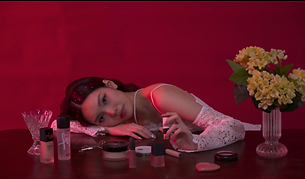
The multilayered image of the artist challenges the stereotype that Vietnamese women have to live up to, which links to Judith Butler's representation theory, as those stereotypical behaviours are socially constructed. The perception originated from the male-dominated culture in Vietnam, and women in the country have to endure all such misogyny unwillingly.
Consistent branding is an essential element in my products, achieved through recurring fonts, colours, language, and design. For instance, the song titled "Moonlight" uses the "Snell Roundhand" font in all three products, providing a consistent and uniform pattern. The font style is old-fashioned, with black, neon pink, purple, and blue as the primary colour scheme, representing a new and bright future.

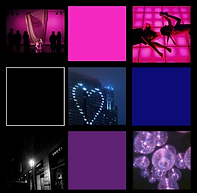
The old-style font implies the traditional outlook of people in Vietnam, where, despite time passing, the rigid perception remains. The colour and font style makes the products recognisable and iconic, allowing the audience to associate them with the artist. The uniform colours are visible mostly in my music videos are black, neon pink, and blue, creating a contrasting feeling. Neon pink is usually associated with positive feelings like enlightenment, while blue and purple connote the opposite.
The colours blue and purple appear consistently in the music video, such as the background, artist's costumes, and LED lights. This was purposely done to reflect the artist's feelings of sorrow for being pressured by societal misconceptions and the video's overall message. The blue and pink colours are repeated in the digipak and Instagram feed of the production company, allowing the audience to connect with the artist's miserable situation.

Additionally, the artist's appearance is consistent throughout all three products, with the same layout used to design the digipak and social media feeds. The diverse image of the artist makes it easier for the products to resonate with the target audience, which aligns with John Hartley's idea that media institutions are obliged to communicate not only about the audience but also about them.
The artist wears the same set of costumes throughout all three products to ensure consistency. Finally, branding is established through the design of the digipak and social media feeds. The use of burning flowers in both works creates an icon of the artist, making it noticeable to the audience.

During the research process of my project, I identified my target audience as young Vietnamese females between the ages of 16 - 24. This group of audience allows my production to be suitable and applicable to a wider range of audiences, enabling the message to be spread further. My music video aims to prove to the world that Vietnamese women are not traditional but strong and multi-layered, which perfectly fits the perspective of the current young generation of women.
Consequently, this relates to the Uses and Gratification theory, where the audience can see themselves within the artist's image based on the need to share experience and identity. Apart from finding themselves, my music video also aims to entertain them through attractive visuals and catchy song melodies.
My Instagram account is the most engaging of my products, designed to interact with others on a personal level through daily posts surrounding the artist's lifestyle and activities. This connection is important to me, as it allows me to connect with my fanbase and encourage participation in the Moonlight dance challenge.


By realising the target audience's hobbies and interests, we created a fashion-related quiz for the most attractive layout of the artist in the music video to make the audience feel valued by contributing their opinion. To convey the message of female empowerment while combating societal pressure, we shared various inspiring quotes on both posts and stories on our Instagram account.
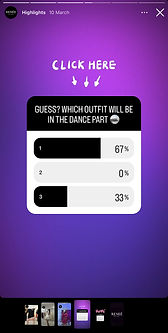
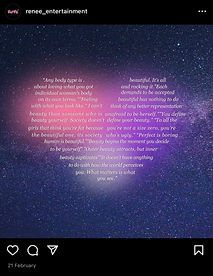
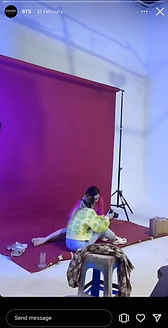
These quotes were aimed at a wider audience beyond Vietnamese women. In addition, we posted behind-the-scenes footage on our highlights section to give our followers a glimpse into the production of our music video. We received multiple rounds of feedback from our audience and made significant changes to ensure our message was conveyed accurately.
Throughout the research process, I delved into various music genres and analysed different music videos until I gathered enough ideas to create my own music video. While researching R&B music, I discovered that male artists have dominated the genre, so I wanted to challenge these conventions by showcasing a successful female artist who spreads inspiring messages.
Furthermore, instead of sticking to the common themes of love and heartbreak, my music video addresses the growing social issues within a specific nation, which challenges the R&B conventions within the music industry in Vietnam. Despite challenging these conventions, I still followed the convention of being performative for the music video, which entailed a lot of choreography.
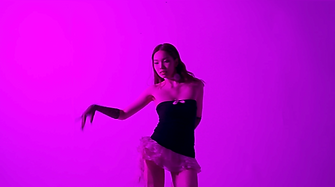
Additionally, the video was created to combine what Andrew Goodwin identifies as the relationship between lyric and visual, as well as music and visual. I made a clear illustrative relationship between the lyrics and visuals by visually representing some of the actions that the lyrics talk about.
Similarly, I used editing techniques such as cutting on the beat and a combination of fast and slow takes to create a relationship between the music and visuals. For instance, when the lyric is "Looking dolly eyes...", the character stares relentlessly at something before turning her head back along the beat.

My artist's persona was inspired by famous artists such as Selena Gomez, Ariana Grande, and Black Pink. I combined their styles when creating my brand, from the music video to the digipak to the Instagram account, to follow some of the trending artists' characteristics and make my work more appealing and eye-catching.